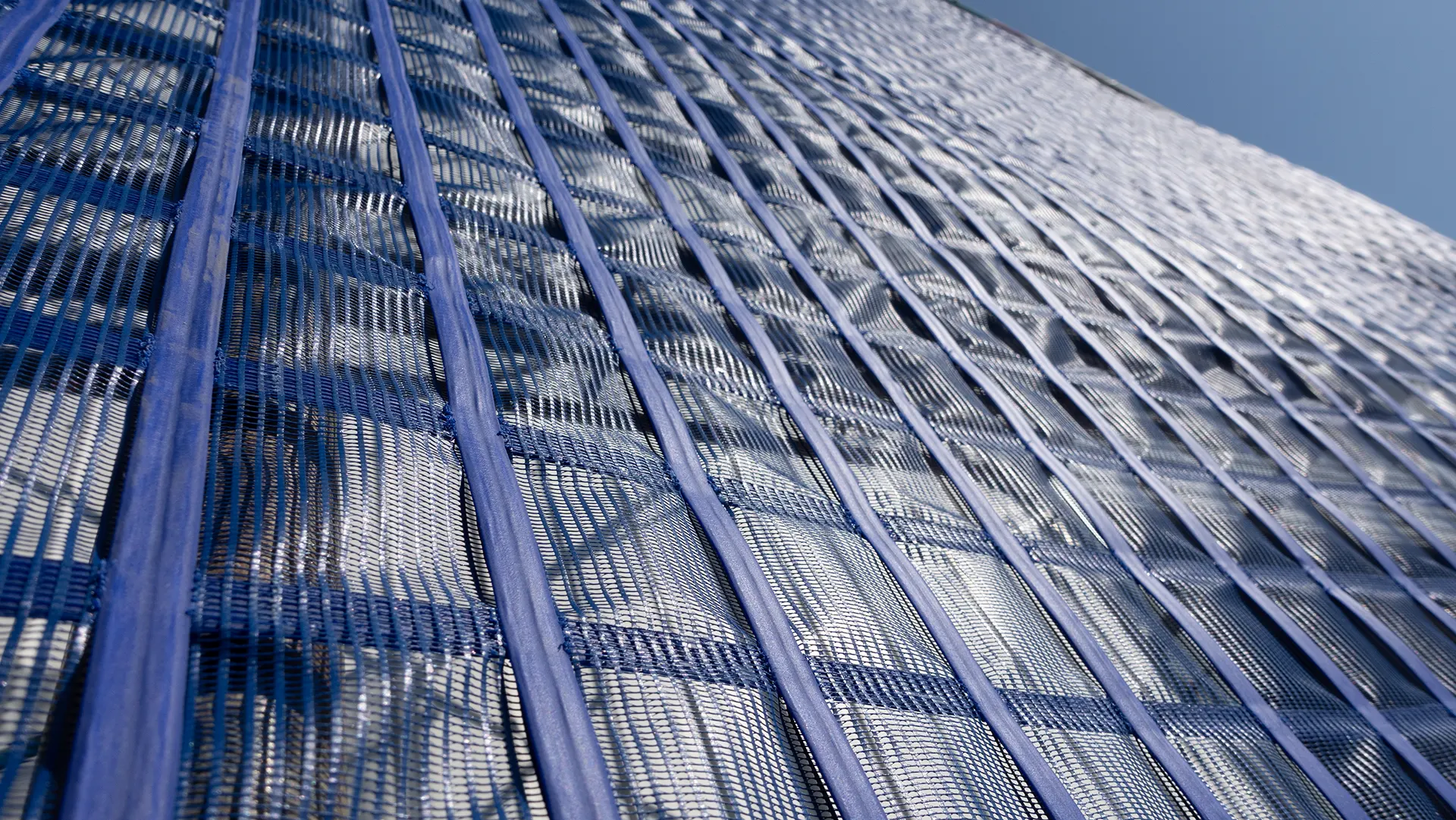
Fire-Retardant Containment Mesh
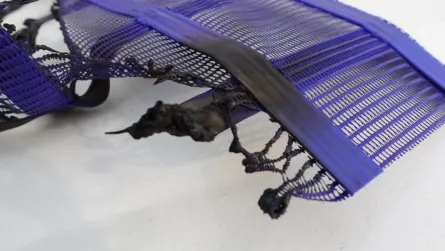
The Fire Retardant Mesh is our flagship safety solution, meticulously designed for high-risk construction environments. Unlike standard meshes, this product integrates advanced passive flame-retardant technology directly into the fiber matrix – while it may be ignited under extreme conditions, it can automatically self-extinguish rapidly without any active fire-suppression intervention.

Across Oceans and Heat Plains: The RM Series Mesh Achieves "Full Climate, Full Compatibility"
Projects
Across Oceans and Heat Plains: The RM Series Mesh Achieves "Full Climate, Full Compatibility"
Taking Australia as an example — from the subtropical climate along the coast to the temperate Mediterranean climate in the southwest, from the desert and semi-arid conditions of the mid-west to the tropical climate of the north — the RM Series Mesh safety net is fully compatible across every climate zone.
I. The Pain Points: Three "Hidden Costs" of Construction Safety Nets
- Safety Hazards: Standard nets have low tensile strength in both directions, a fragile structure, and extremely poor fall protection and wind resistance, requiring multiple replacements during a project to ensure construction safety.
- Flame Retardancy: Most standard nets are made of PE material with a certain proportion of flame retardant added, resulting in poor flame retardant effect. They pose a significant fire hazard and are prone to producing deadly "melt drips."
- Inefficient Installation: The net body does not have structural load-bearing capacity. If a construction site requires fall protection, workers must first install a layer of metal wire mesh on the scaffolding, and then tie the standard net to the outside of the wire mesh with zip ties. This "double-layer construction" is extremely time-consuming and labor-intensive, resulting in exorbitant labor costs.

II. The Solution: Next-Generation Fire-Retardant Containment Mesh
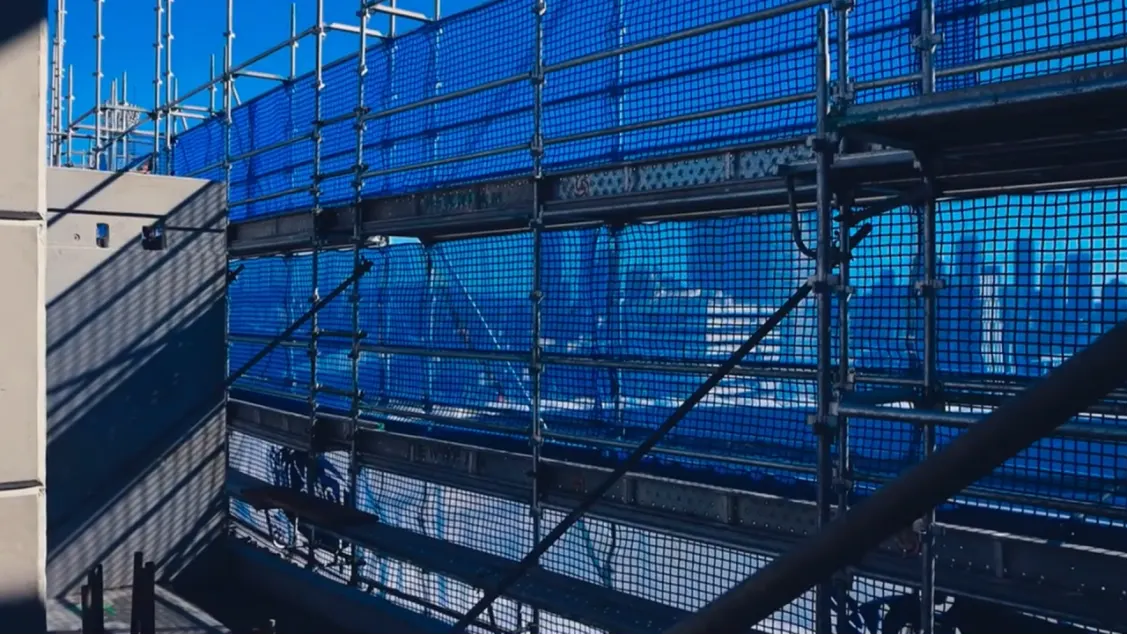
Core Positioning: A scaffolding safety net that achieves a comprehensive breakthrough in four key dimensions: durability, flame retardancy, installation efficiency, and environmental recyclability.
| Performance Dimension | Standard Market Products | ★ RM Series Mesh | Customer Value |
|---|---|---|---|
| Outdoor Design Life | 0.5 – 2 years | 3 – 4.5 years (Based on a 70% strength retention safety threshold) | No need to replace protection nets during long-term projects; can even be reused on the next project, significantly reducing long-term material costs. |
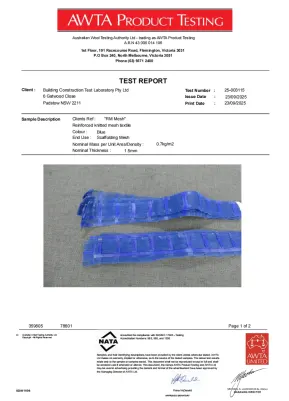
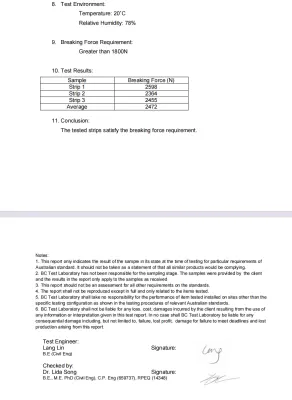
| Tensile Strength (AS 2001.2.3.1) | 300N – 700N | Single strand tensile strength ≥ 2.4 KN | Significantly reduces the risk of fatal safety accidents on site. Protects workers and helps contractors avoid huge compensation claims, work stoppages, investigations, and potential lawsuits. Local tears/damage do not require full net replacement; repairs are simple and do not affect overall net strength, reducing material and labor costs. |
| Flame Retardancy (AS1530.2) | Flammability index typically around the passing mark; still produces some melt drips when burning | Flammability index ≤ 2, self-extinguishing, no melt drips | Quickly prevents fire from spreading along the protection net and prevents burning plastic drips from igniting materials below or seriously burning evacuees. |
| Installation Efficiency | Low; does not have structural load-bearing capacity; requires "double-layer construction," extremely time-consuming and labor-intensive | 50% faster, with comprehensive multi-point fixing that improves installation efficiency and overall protection | Saves a significant amount of valuable installation and dismantling labor costs, allows projects to progress faster, and reduces the risk of working at heights. |
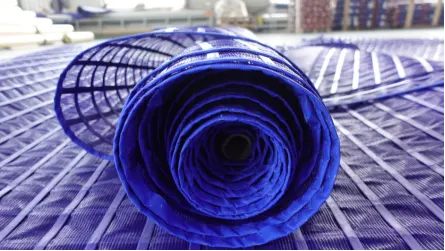
| Reusability | Extremely low turnover rate; typically treated as a single-use consumable | High turnover rate; supports multi-project recycling | Transforms from a "consumable" into a "reusable asset" that can be circulated across multiple projects. |
| Operating Temperature Range | −30°C to 70°C | −30°C to 80°C | Under extreme summer heat and intense sunlight, the material is less prone to aging and brittleness. For regions with hot climates or strong UV radiation, this ensures that the protection net's safety performance does not degrade during high-temperature operations. |
| Environmental Recyclability | Recyclable | Recyclable | Fully meets various stringent engineering test standards while helping modern construction projects achieve green building metrics. |
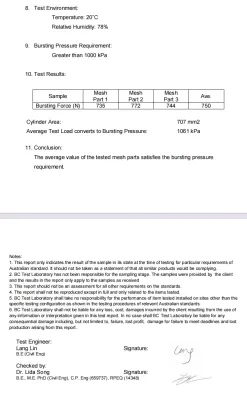
| Certification Standards | AS 1530.2 / AS 2001.2.3.1 / AS 2001.2.4 | AS 1530.2 / AS 2001.2.3.1 / AS 2001.2.4 | Meets market standards. |
III. Evidence: Real-World Project Data from Australia
This project was executed under an OEM partnership model and has been successfully deployed in the Australian market. Due to partner branding requirements, the specific project owner's name is not disclosed. All data below are real engineering records.
Project Overview
| Project Type | Large-scale commercial complex (high-rise building cluster) |
| Location | Sydney, Australia |
| Construction Period | Approximately 18 months |
| Coverage Area | Single coverage of approximately 8,000 m²; cumulative use of approximately 16,000 m² |
| Climate Challenges | Subtropical humid climate, strong UV, high rainfall, salt spray environment |
| Duration of Use | Continuous use for 16 months |
Core Data Comparison & Cost Savings Analysis
Cost & Performance Comparison: Traditional vs. RM Series Mesh
Normalized bar chart comparing key metrics – values are relative to traditional product (set to 100%)
Single Purchase Cost Traditional (AUD 65,000) RM Series (AUD 32,000)
Total Purchase Area Traditional (16,000 m²) RM Series (8,000 m²)
Net Failures Causing Safety Incidents Traditional (20+ incidents) RM Series (2 tears, zero safety breach)
Total Labor Hours (Install, Remove, Repair) Traditional (1,600 hrs) RM Series (1,000 hrs)
Installation Labor Cost Traditional (AUD 98,000) RM Series (AUD 61,000)
Total Cost (Materials + Labor) Traditional (AUD 163,000) RM Series (AUD 93,000)
* Traditional product values normalized to 100% width for visual comparison. Actual savings shown in percentages.
RM Series Mesh: 2 localized tears occurred during the 16-month project, but the high-strength structure prevented any falling objects or injuries — zero safety incidents. Traditional nets: 20+ failures resulted in multiple falling object hazards and work stoppages.
RM Series Mesh: 2 localized tears occurred during the 16-month project, but the high-strength structure prevented any falling objects or injuries — zero safety incidents. Traditional nets: 20+ failures resulted in multiple falling object hazards and work stoppages.
Client Feedback
"What impressed us most about this product are two things: first, after 16 months the net is still intact, and based on our experience it can still be used for at least one more project; second, the quick-install system reduced the time to enclose each floor from half a day to just 2 hours, and the entire project was completed 12 days ahead of schedule."
IV. Technical Specifications Overview
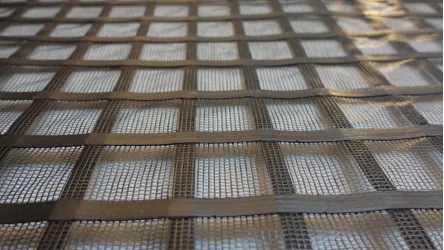
| Material | PVC + High-tenacity polyester fiber |
| Mesh Size | 50mm × 50mm (customizable) |
| Maximum Width | 4 meters (customizable) |
| Tensile Strength | Single strand strength ≥ 2.4 KN |
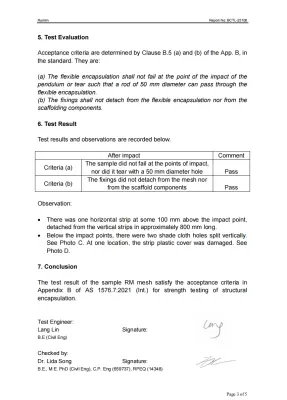
| Flame Retardancy | AS1530.2 Flammability Index ≤ 2 |
| Design Life | 3 – 4.5 years (Based on 70% strength retention safety threshold) |
| Operating Temperature | −30°C ~ 80°C |
| Corrosion Resistance | Salt spray / acid & alkali resistant |
| Environmental Features | Reusable and recyclable |
| Certifications | AS 1530.2 / AS 2001.2.3.1 / AS 2001.2.4, etc. |
V. Why Choose Us
| Comparison Dimension | Standard Market Products | ★ RM Series Mesh |
|---|---|---|
| Service Life | 6 months – 2 years | 3 – 4.5 years |
| Flame Retardant Durability | Coating prone to degradation | Chemically stable; long-term effective |
| Installation Efficiency | Low | 40% faster |
| Reusability | Not supported | Supported |
| Environmental Recyclability | Recyclable | Recyclable |
| Climate Adaptability | Overall weak | Full coverage across all climate zones in Australia |
From "Consumable" to "Competitive Advantage"
Choose a fire-retardant net that truly understands the construction site.
Contact us to get: Product samples · Complete technical data · One-on-one project consultation · Tailored selection recommendations for your project's specific location.
Inquire Now →Note: The case data is compiled from actual project implementations in Australia. Due to OEM agreement requirements, the client name has been withheld. All data are authentic engineering records, not simulated calculations.